Universities
Taras Shevchenko National University MBBS 2026: FMGE, NMC
28 Jul 2026
12 min read
Taras Shevchenko National University of Kyiv: 6-year English Medicine course, NBEMS FMGE results 2023 to 2025, NMC rules and India's Ukraine travel advisory.
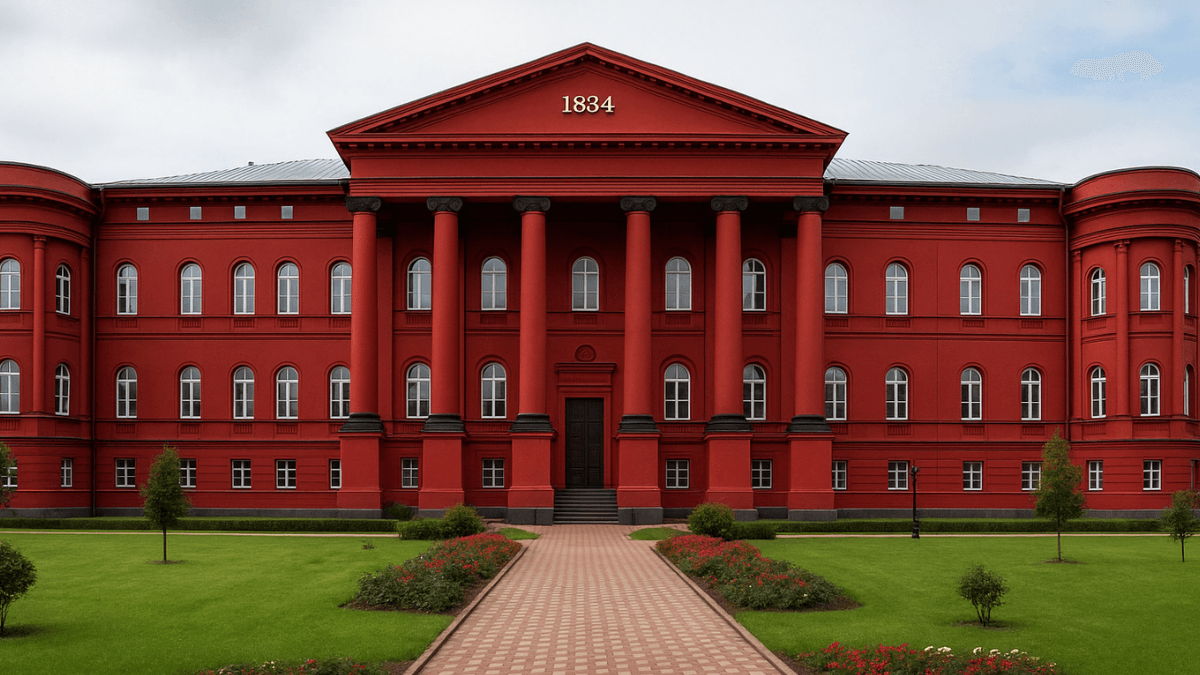
Taras Shevchenko National University of Kyiv is a state university in Kyiv, Ukraine, founded in 1834. It teaches a 6-year Medicine programme in English. Its graduates passed FMGE, the licensing exam for foreign doctors in India, at 28.00% in December 2025. Ukraine remains at war, and India advises against travel there.
Updated on 30 September 2026.
Key Takeaways
Founded in 1834. The university opened in Kyiv on 15 July 1834 as the Imperial University of Saint Volodymyr. It gained "National" status on 21 April 1994 (Taras Shevchenko National University history page).
Medicine sits inside a wider university. The English Medicine programme is run by the Educational and Scientific Centre "Institute of Biology and Medicine", one unit of a classical university (Institute of Biology and Medicine page).
6 years, Master of Medicine. The programme carries 360 ECTS credits over 6 academic years and leads to the qualification Master of Medicine (2025 educational programme for Medicine taught in English).
Listed on WDOMS. WDOMS, the World Directory of Medical Schools, lists the Institute of Biology and Medicine as a public school, currently operational, with FAIMER School ID F0005857 (WDOMS entry for the Institute).
FMGE results are above the national average. Graduates passed FMGE at 31.58% in June 2025 and 28.00% in December 2025, against national rates of 18.62% and 23.94% (NBEMS FMGE Performance Report 2025).
India's advisory still stands. The latest advisory on the Embassy of India in Kyiv's advisory page, dated 25 October 2022, asks all Indian citizens in Ukraine to leave by available means (Embassy of India advisory of 25 October 2022).
Not a futureMBBS partner. futureMBBS works with 23 partner universities in 9 European countries. Ukraine is not one of them (futureMBBS partner universities).
What is Taras Shevchenko National University?
Taras Shevchenko National University of Kyiv is a state research university in Kyiv, Ukraine. It teaches law, sciences, humanities and medicine. About 26,000 students study there, plus around 1,660 postgraduate students (Taras Shevchenko National University official website).
Medicine is taught by one unit: the Educational and Scientific Centre "Institute of Biology and Medicine". Its administration sits at 2 Hlushkova Avenue, Kyiv (Institute of Biology and Medicine page). For the wider picture of studying medicine in the country, read our MBBS in Ukraine guide.
Taras Shevchenko National University at a glance
Item | Detail |
|---|---|
City | Kyiv, Ukraine |
Type | State classical research university, under the Ministry of Education and Science of Ukraine |
Medical unit | Educational and Scientific Centre "Institute of Biology and Medicine" |
Medical programme for foreign students | Medicine (taught in English), speciality I2 Medicine, full time |
Length | 6 academic years, 360 ECTS credits |
Qualification | Master of Medicine |
WDOMS listing | FAIMER School ID F0005857, public, medical instruction started in 2017 |
Language | English, with Ukrainian taught as a subject |
Final exams | KROK 1, KROK 2, a professional English exam and a clinical practical exam (OSCE) |
Sources for the table: the WDOMS entry, the list of master programmes for foreign students, the Medicine programme description page and the 2025 educational programme for Medicine.
History of Taras Shevchenko National University
The university has a long history. Its medical faculty was split off in 1920. Medicine returned much later through the Institute of Biology and Medicine.
Year | What happened |
|---|---|
1833 | On 8 November 1833, the plan to found the Imperial University of Saint Volodymyr is approved |
1834 | The university is inaugurated on 15 July 1834 and starts teaching on 28 August with 62 students |
1841 | The Medical School opens, based on the closed medical school of Vilnius University |
1920 | Kyiv University is disbanded. A separate Medical Institute is formed from its medical faculty |
1933 | Kyiv State University is re-established |
1994 | On 21 April 1994, the university receives "National" status by presidential decree |
Source: the Taras Shevchenko National University history page. Kyiv's dedicated medical university is covered in our Bogomolets National Medical University guide.
Medicine at Taras Shevchenko National University: the programme
The English Medicine programme is a 6-year integrated degree. Students enter after school, with complete secondary education. The degree awarded is a Master of Medicine, at level 7 of the European qualifications framework (2025 educational programme for Medicine). In India, this is the foreign equivalent of MBBS.
Teaching is in English. Ukrainian is taught as a foreign language subject, including a professional course. This matters because patients in Ukrainian hospitals speak Ukrainian.
How students are assessed
KROK 1. Ukraine's national licensing test on basic medical sciences, taken during the programme.
KROK 2. The national licensing test on clinical medicine, taken near the end of the degree.
English exam. A test of professional English, part of the final state exam.
OSCE. An objective structured clinical exam, where students show practical skills at stations.
Source: the assessment section of the 2025 educational programme for Medicine.
Departments of the Institute of Biology and Medicine
Basic and pre-clinical departments | Clinical departments |
|---|---|
Anatomy and Pathologic Physiology; Physiology and Anatomy | Internal Medicine |
Biochemistry; Biomedicine | Surgery |
Biophysics and Medical Informatics | Clinical Medicine |
Cytology, Histology and Reproductive Medicine | Fundamental Medicine |
General and Medical Genetics; Microbiology and Immunology; Virology | University Clinic (other unit) |
The Institute also runs a Department of Language Training. Out-of-town undergraduates live in Dormitory No. 9 (Institute of Biology and Medicine page).
Is it safe to study at Taras Shevchenko National University in 2026?
Ukraine has been at war since February 2022. The Government of India's position is set out in advisories from the Embassy of India in Kyiv. The latest advisory listed on the Embassy of India advisory page is dated 25 October 2022. No later advisory has replaced it.
Date | What the Embassy of India in Kyiv advised |
|---|---|
10 October 2022 | Avoid all non-essential travel to and within Ukraine. Follow Ukrainian safety guidelines and keep the Embassy informed (advisory of 10 October 2022) |
19 October 2022 | Indian nationals are advised against travelling to Ukraine. Indian citizens, including students, should leave Ukraine at the earliest (advisory of 19 October 2022) |
25 October 2022 | All Indian citizens in Ukraine are advised to leave immediately by available means (advisory of 25 October 2022) |
The Institute of Biology and Medicine is still running. Its September 2026 announcements list lectures and classes, and some are held with distance technology (Institute of Biology and Medicine announcements). That tells a family the university is teaching. It does not change India's travel advisory.
For a wider view of safety across study destinations, see our guide on whether MBBS abroad is safe.
Taras Shevchenko National University FMGE pass rate
FMGE is the Foreign Medical Graduate Examination. A doctor with a foreign medical degree must pass it before working in India. NBEMS, the National Board of Examinations in Medical Sciences, runs it and publishes results by university (NBEMS FMGE page).
FMGE exam | Appeared | Passed | Taras Shevchenko National University pass rate | All candidates pass rate |
|---|---|---|---|---|
2023 (both exams) | 9 | 4 | 44.44% | 16.65% |
2024 (both exams) | 39 | 17 | 43.59% | 25.80% |
June 2025 | 19 | 6 | 31.58% | 18.62% |
December 2025 | 25 | 7 | 28.00% | 23.94% |
Sources: NBEMS FMGE 2023 report, NBEMS FMGE 2024 report and NBEMS FMGE Performance Report 2025. NBEMS lists the university as "Taras Shevchenko National University of Kyiv Institute of Biology and Medicine".
Two points matter here. First, the groups are small, so one or two candidates move the rate a lot. Second, the rate has fallen from over 40% to around 28%, roughly one in four.
For comparison, all Ukraine-trained candidates passed at 18.62% in June 2025 (546 of 2,933) and 21.48% in December 2025 (638 of 2,970) (NBEMS FMGE Performance Report 2025). Our web story on FMGE pass rate by country puts these figures side by side.
NMC rules for Taras Shevchenko National University graduates
NMC, the National Medical Commission, regulates doctors in India. It does not keep or endorse a list of approved foreign universities (NMC information for students studying abroad). A foreign degree counts only if the course meets the NMC Foreign Medical Graduate Licentiate (FMGL) Regulations, 2021.
WDOMS lists the Institute of Biology and Medicine with FAIMER School ID F0005857. It records 2017 as the year medical instruction started, and the school as currently operational (WDOMS entry for the Institute). A WDOMS listing shows the school exists and teaches medicine. The FMGL rules below decide whether the degree counts in India.
FMGL requirement | What it means for a student |
|---|---|
Course of at least 54 months | The 6-year Medicine programme is longer than this minimum |
12-month internship in the same foreign institution | The internship must be done at the same university, not elsewhere |
Medium of instruction in English | The degree must be taught in English |
Entire course at the same institution outside India | No part of the training or internship can be done in India or another country |
Licence to practise in the country of study | The graduate must be registered, or eligible to register, as a doctor in Ukraine |
Course completed within 10 years of joining | Delays beyond 10 years make the degree ineligible |
Pass FMGE, then 12 months of supervised internship in India | Both steps come after returning, before full registration |
Source: NMC FMGL Regulations, 2021. NMC also says Indian students joining a foreign medical course from May 2018 must qualify NEET UG (NMC information for students studying abroad). Our guide on how to check NMC and WDOMS recognition walks through each check.
Does futureMBBS offer admission to Taras Shevchenko National University?
No. futureMBBS works with 23 partner universities in 9 countries: Czech Republic (5), Hungary (4), Poland (3), Slovakia (3), Croatia (2), Latvia (2), Romania (2), Cyprus (1) and Lithuania (1). Ukraine is not one of them (futureMBBS partner universities).
Families comparing options can read our MBBS in Hungary country guide, one of the partner countries. Other Ukrainian universities are covered in our guides to Kyiv Medical University and Kharkiv National Medical University.
Conclusion: Taras Shevchenko National University in 2026
Taras Shevchenko National University of Kyiv runs a 6-year English Medicine programme, and it is still teaching in 2026. Its graduates have passed FMGE above the national average in every year from 2023 to 2025, though the rate has fallen to about one in four.
The deciding fact for an Indian family is the war. The Embassy of India in Kyiv has advised Indian nationals against travel to Ukraine since October 2022, and that advice has not been withdrawn.
Sources
Taras Shevchenko National University: Institute of Biology and Medicine
Taras Shevchenko National University: master's programmes for foreign students
Institute of Biology and Medicine: Medicine programme description
Institute of Biology and Medicine: 2025 educational programme for Medicine (taught in English)
WDOMS: Taras Shevchenko National University of Kyiv Institute of Biology and Medicine
Related Topics
- Taras Shevchenko National University
- MBBS in Ukraine
- Kyiv medical university
- NMC recognition
- futureMBBS
Related Articles
 Universities28 Jul 202616 min read
Medical College Vadodara: 2026 NEET Cutoff and Seats
Medical College Vadodara (Baroda) MBBS 2026: 250 NMC seats, official MCC closing ranks for 2025 and 2026, Rs. 20 lakh bond, SSG Hospital and admission steps.
 Universities28 Jul 202616 min read
MP Shah Medical College Jamnagar: 2026 Cutoff, Seats
MP Shah Medical College Jamnagar has 250 MBBS seats. 2026 AIQ Open cutoff was rank 6,233 in Round 1 and 8,289 in Round 2. Quotas, eligibility, dates, documents.
 Universities28 Jul 202620 min read
MGM Medical College Indore 2026: Cutoff, Fees, Seats
MGM Medical College Indore 2026: 250 MBBS seats, Rs. 1 lakh yearly tuition, MCC and MP state closing ranks for 2025 and 2026, seat matrix, bonds and dates.