Prof. Linda Doyle (Provost)
Professor Linda Doyle is the 45th Provost of Trinity College Dublin, having taken office in August 2021: the first woman to lead the university in its history, and an internationally recognised engineer and researcher.
Webinar: Pursuing MBBS in India Thu, November 5, 2026 | 8:30 PM IST FREE
Reserve free seatFree Webinar: MBBS in India
Thu, November 5, 2026 | 8:30 PM

Free Webinar: MBBS in India
Thu, November 5, 2026 | 8:30 PM
Ireland's oldest and highest-ranked medical school, a world top-100 medical education (QS 83rd for Medicine) in the heart of Dublin, taught in English.


5000+ Students trust us
Ireland
Country (EU member)
Dublin
Capital city
Est. 1592
Medicine since 1711
English
Medium of instruction
Introduction
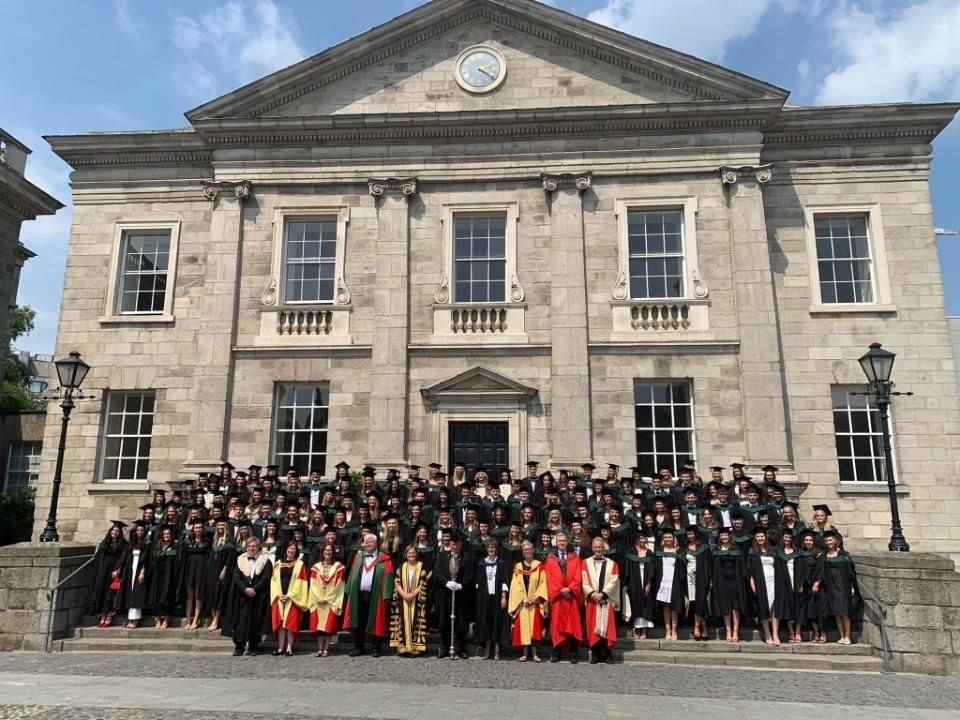



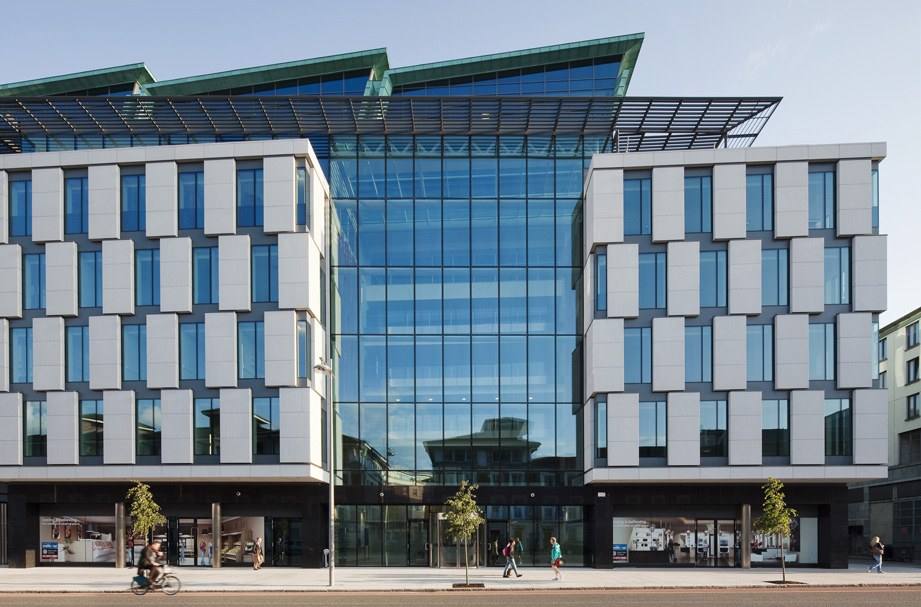
A Trinity College Dublin building on the historic Dublin campus
Download our free brochure for immediate information, or get personalised professional counselling from our experts.
Recognition & Prestige
Trinity is Ireland's oldest university and its leading medical school, ranked among the world's top medical schools, accredited by the Irish Medical Council in line with WFME standards, listed in WDOMS, and recognised by the UK GMC.
QS 83rd
world rank: Medicine (QS 2025)
#1
medical school in Ireland
The medical degree is recognised internationally. Trinity College Dublin is listed in the World Directory of Medical Schools (WDOMS); its MB BCh BAO is accredited by the Irish Medical Council in accordance with World Federation for Medical Education (WFME) standards; and it is recognised by the UK General Medical Council (GMC) and accepted by the ECFMG for the US route. Ireland is a member of the European Union and the European Higher Education Area. The degree does not meet the NMC's FMGL Regulations 2021, so it does not lead to the FMGE or to practice in India.
NMC (India)
Does not meet the NMC's FMGL Regulations 2021: the degree has no 12-month internship at the same university, so it does not lead to practice in India.
WDOMS
Listed in WDOMS, the World Directory of Medical Schools.
WFME / Irish Medical Council
The MB BCh BAO is accredited by the Irish Medical Council in accordance with World Federation for Medical Education (WFME) standards, meeting the 2024 ECFMG requirement for the US route.
EU Member State
Ireland is a member of the European Union and the European Higher Education Area, and the MB BCh BAO is also recognised by the UK General Medical Council (GMC), supporting recognition and mobility across Europe and beyond.
Complete Information About Trinity Medicine
Get complete information about the Trinity College Dublin School of Medicine, including tuition, living costs, admission and what the degree means for Indian students.
Success stories
Hear directly from students who are studying medicine in Europe with futureMBBS.
Academic Excellence
Trinity offers a world top-100 medical education in English, at Ireland's oldest university, with clinical training in Dublin's major teaching hospitals and a globally recognised degree, a prestige option for students who can meet its competitive academic bar.
Read all about MBBS abroad in our free brochure
Know exactly what options exist for your MBBS-abroad success.
How to Apply
Admission to the five-year MB BCh BAO at Trinity is academically competitive. International (non-EU) applicants, including Indians, apply directly to Trinity on the strength of their Class 12 results and English proficiency, and, unlike EU applicants, are not required to sit the HPAT. Trinity's own selection is based on strong academic performance. NEET UG is not part of admission here, and because this degree does not meet the NMC's rules, NEET UG does not open a route to practise in India from it.
International applicants apply through Trinity's international admissions route (or an approved representative) with Class 12 certificates, English test and supporting documents, ahead of the published deadline for the September intake.
Trinity assesses applicants on their Class 12 results (competitive grades required, with Chemistry and a second science/biology) and English proficiency; medicine is highly selective, so strong marks are essential.
Successful applicants receive an offer of a place on the MB BCh BAO programme, subject to meeting all conditions.
Admitted students accept the offer and pay the required tuition deposit to secure their place.
Students apply for the Irish student visa (D study visa) using Trinity's admission letter and proof of funds, and complete immigration registration on arrival.
The academic year begins for the new intake in Dublin.
Applicants must have completed Class 12 (or equivalent) with high grades in Physics, Chemistry and Biology; medicine at Trinity is highly competitive, so strong marks (well above minimum passes) are expected. NEET UG is not part of admission here, and because this degree does not meet the NMC's rules, NEET UG does not open a route to practise in India from it.
Subjects:
Candidates should be at least 17 years old in the year of admission, in line with standard MBBS-abroad requirements.
Applicants submit Class 12 certificates and mark sheets, an English-proficiency test and a valid passport. NEET UG is not part of admission here, and because this degree does not meet the NMC's rules, NEET UG does not open a route to practise in India from it.
Class 12 & English
Competitive Class 12 results with Chemistry and Biology (and typically Physics/Maths), plus an English test such as IELTS or TOEFL at the required level. Non-EU applicants are not required to sit the HPAT.
NEET (for Indian students)
NEET UG is not part of admission here, and because this degree does not meet the NMC's rules, NEET UG does not open a route to practise in India from it.
Non-EU applicants are not required to sit Ireland's HPAT for entry to Trinity medicine; selection is by Class 12 results and English proficiency. NEET UG is not part of admission here, and because this degree does not meet the NMC's rules, NEET UG does not open a route to practise in India from it.
| Component | Requirement |
|---|---|
| HPAT (non-EU) | Not required for non-EU applicants to Trinity medicine; selection is by Class 12 results and English. |
| English test | IELTS / TOEFL (or equivalent) at Trinity's required level. |
| NEET (Indian students) | Not part of admission. Because this degree does not meet the NMC's rules, NEET UG does not open a route to practise in India from it. |
To apply, students need to submit essential academic and identification documents:
Admission Guidance & Document Checklist
Get the complete document checklist or admission guidance from our experts.
Programme Structure
The five-year MB BCh BAO builds from foundational science to full clinical practice: early years cover pre-clinical and para-clinical science, the middle and later years bring clinical rotations in Dublin's teaching hospitals, and the final year prepares students for practice, all taught in English.
Total Duration:
5 Years (direct entry, including clinical years)
Degree:
MB BCh BAO (Bachelor of Medicine, Bachelor of Surgery, Bachelor of Obstetrics), equivalent to MBBS
Years 1–2
Foundational and pre-clinical medical sciences covering the structure and function of the human body, taught through lectures, laboratories, small-group and problem-based learning, with early patient contact:
Year 3
Para-clinical sciences and the transition to the clinical environment, bridging laboratory science and bedside medicine ahead of full clinical rotations:
Years 4–5
Clinical clerkships across the major specialties in Trinity's Dublin teaching hospitals, building to the final year and preparation for practice and, in Ireland, the intern year that follows the degree:
Clinical training takes place in Trinity's affiliated Dublin teaching hospitals (including St James's Hospital and Tallaght University Hospital) from the middle years onwards, building to full clinical rotations across the specialties.
| Phase | Focus |
|---|---|
| Years 1–2 | Pre-clinical science through lectures, laboratories and small-group/problem-based learning, with early patient contact. |
| Year 3 | Para-clinical science and the transition to the clinical environment. |
| Years 4–5 | Clinical clerkships across the specialties in Dublin teaching hospitals, and the final year. |
Get the full curriculum
Download a free brochure to see detailed subjects, the course structure and everything you need to plan your studies.
Global Exchange
As a full EU member-state university, Trinity maintains extensive international partnerships and student-exchange agreements across Europe and worldwide, and takes part in the Erasmus+ programme. Exchanges are managed through Trinity's Global Relations and academic offices under its cooperation and Erasmus+ agreements.
| Country | University |
|---|---|
| France | Sorbonne Université |
| Czechia | Charles University (Prague) |
| Denmark | Aarhus University |
| Belgium | University of Antwerp |
| Germany | Johannes Gutenberg University Mainz |
Explore Your Options
Trinity students can take part in international exchange. Get the latest details and guidance from our experts.
Legacy
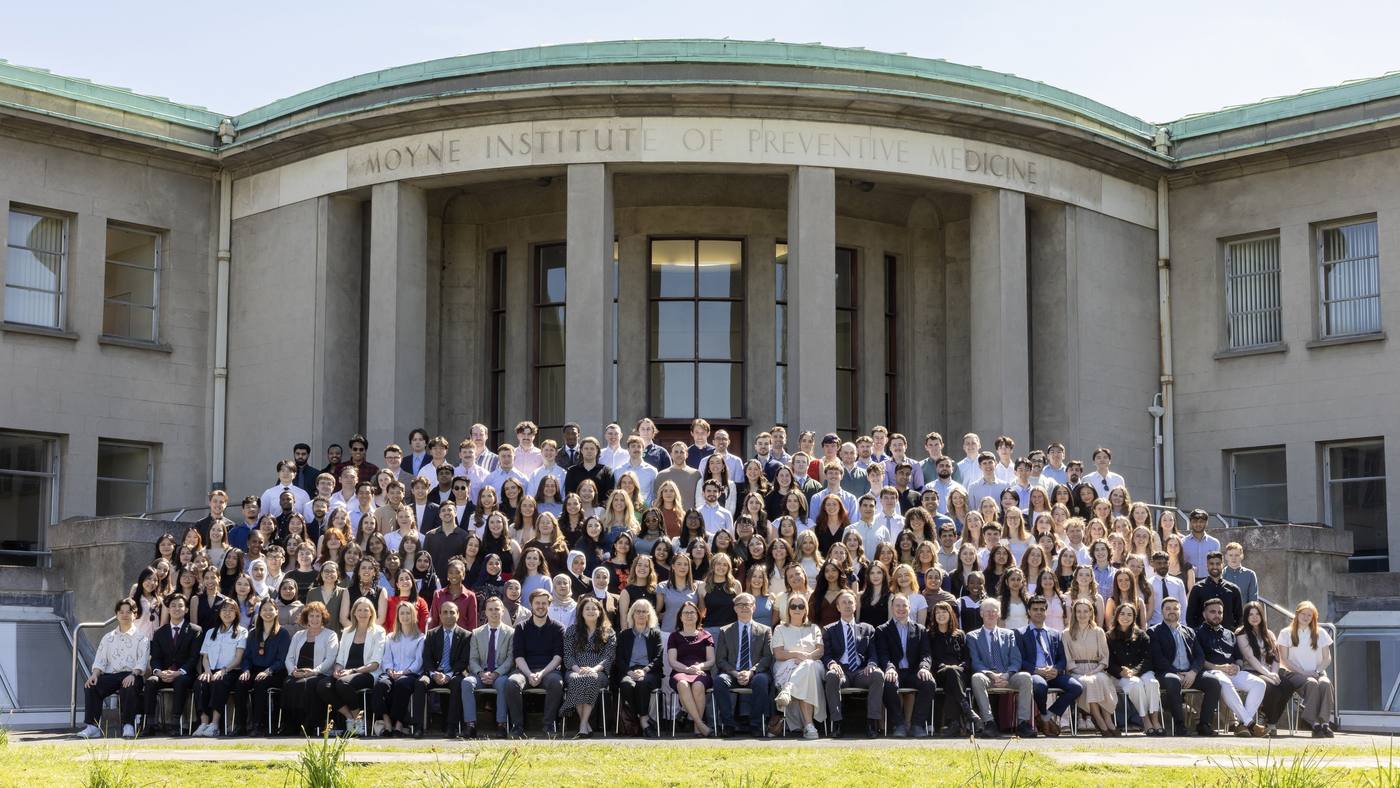
Trinity College Dublin has educated generations of leaders across medicine, science, literature and public life, and is led today by senior academics.
Professor Linda Doyle is the 45th Provost of Trinity College Dublin, having taken office in August 2021: the first woman to lead the university in its history, and an internationally recognised engineer and researcher.
Trinity's School of Medicine is home to more than 800 researchers across 21 medical and scientific disciplines, with clinical teaching in Dublin's major teaching hospitals, and is led by senior academic and clinical staff.
Ireland's #1 medical school (QS 83rd, Medicine)
800+ researchers across 21 disciplines
Research-intensive faculty
English-taught, internationally recognised MB BCh BAO
Clinical teaching in major Dublin hospitals
Personal tutor system
A large international community
Strong student support services
About University
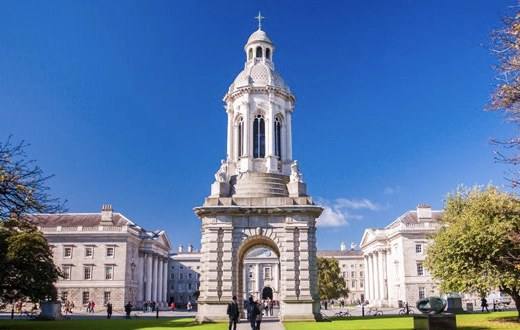
A historic Trinity College Dublin building in Dublin
Get all information about Trinity in our free brochure
Read on to find out how you can pursue your dream of studying medicine at Trinity College Dublin.
Role in medicine
Get all information about Trinity in our free brochure
Read on to find out how you can pursue your dream of studying medicine at Trinity College Dublin.
Cost of study
Dublin is a capital city with a relatively high cost of living, especially for accommodation. Here is the approximate monthly breakdown for an international student, quoted in Indian rupees. (Tuition is separate, roughly ₹52 lakh+ per year.)
| Cost Component | Approximate Amount |
|---|---|
| Accommodation (student residence or shared flat) | ₹75,000 – ₹1,35,000 |
| Food | ₹25,000 – ₹40,000 |
| Transportation (Leap card, bus/Luas) | ₹5,000 – ₹9,000 |
| Other Expenses (utilities, internet, books, leisure) | ₹18,000 – ₹35,000 |
Average monthly living cost
₹1,25,000 – ₹2,15,000
Housing
Trinity offers on-campus and university-managed student residences, and many students rent private accommodation in Dublin. Housing in Dublin is in high demand and relatively expensive, so early planning is important.
Need accommodation details?
Get a full overview of housing options with our university guide, or reach out to an expert.
Food & Dining
Dublin has a large Indian community, so Indian and vegetarian food is widely available alongside campus catering, grocery stores and easy self-catering.
Trinity's campus cafés and Dublin's many cafés and restaurants offer a range of meals, with vegetarian and vegan options widely available.
Dublin has a wide choice of Indian restaurants serving dal, roti, sabzi, biryani and curries, with plenty of vegetarian dishes, reflecting the city's large Indian community.
Dublin has several Indian and Asian grocery stores where students can buy rice, lentils, flour, spices and ready-mixes to cook at home.
Student residences and rented flats have kitchens where students can cook their own meals, the most economical way to enjoy home-style Indian vegetarian food in an expensive city.
Dublin has reliable delivery services such as Deliveroo, Just Eat and Uber Eats, letting students order meals and groceries, including from Indian restaurants, to their door.
Location
Trinity College Dublin, College Green, Dublin 2, D02 PN40, Ireland
Nearest Airport
Dublin Airport (DUB) is about 12 km from the city centre, with one-stop connections to India via Gulf, UK and European hubs.
Local Transport
Trinity's city-centre campus is served by Dublin Bus, the Luas tram and DART rail (student Leap card), connecting the university with student areas and teaching hospitals.
Your Roadmap to Success
On completing the programme, graduates earn the Trinity MB BCh BAO, equivalent to an MBBS, from a world top-100 medical school accredited by the Irish Medical Council and listed in the World Directory of Medical Schools.
An Irish medical degree does not meet the NMC's rules for practising in India. The five to six-year direct-entry course is long enough, but the four-year graduate-entry course is short of the 54 months the NMC requires. Neither includes the 12-month internship at the same university that the NMC's FMGL Regulations 2021 ask for, because the intern year in Ireland is a hospital job allocated by the HSE. Non-EEA graduates without permission to work are ranked in the lowest tiers for intern posts, and no post is guaranteed (HSE intern guide 2026). Ireland is also not covered by the FMGE exemption for postgraduates from Australia, Canada, New Zealand, the UK and the USA.
The MB BCh BAO is recognised by the Irish Medical Council and the UK GMC, and as an EU degree it supports routes into practice and postgraduate training in Ireland, the UK and across Europe (with the relevant licensing steps).
Because Trinity is accredited to WFME standards, it meets the 2024 ECFMG requirement, so graduates can pursue ECFMG certification and the USMLE for residency in the United States.
After the primary degree and intern year, graduates can pursue postgraduate specialty training in Ireland, the UK, the US or elsewhere, subject to each country's licensing rules.
With Trinity's research strength, graduates are well placed for careers in clinical practice, academic medicine and medical research worldwide.
Understand the Medical Licensing Pathway
A clear overview of the exams and requirements after graduation.
Practising in India
An Irish medical degree does not meet the NMC's rules for practising in India. The five to six-year direct-entry course is long enough, but the four-year graduate-entry course is short of the 54 months the NMC requires. Neither includes the 12-month internship at the same university that the NMC's FMGL Regulations 2021 ask for, because the intern year in Ireland is a hospital job allocated by the HSE. Non-EEA graduates without permission to work are ranked in the lowest tiers for intern posts, and no post is guaranteed (HSE intern guide 2026). Ireland is also not covered by the FMGE exemption for postgraduates from Australia, Canada, New Zealand, the UK and the USA.
Step 1
Graduates first complete the five-year MB BCh BAO at Trinity. The course does not include the 12-month internship at the same university that the NMC's FMGL Regulations 2021 ask for, so it does not lead to the FMGE or to practice in India.
Step 2
The intern year in Ireland is a 12-month hospital job allocated by the HSE, not part of the university course. Non-EEA graduates without permission to work are ranked in the lowest tiers for intern posts, and no post is guaranteed.
Step 3
Completing the intern year leads to the Medical Council of Ireland's Certificate of Experience and full registration to practise in Ireland. It does not give registration with the NMC or a State Medical Council in India.
Student Life Style
Being a medical student at Trinity is a mix of intensive academics and life in a vibrant, historic university in the heart of Dublin, with one of the world's most active student-society scenes.
Scholarship & Financial
Trinity offers a range of scholarships and awards, some open to international students, though medicine fees are high and most non-EU students self-fund with family support or education loans.
Trinity offers a number of merit-based global and international scholarships and awards; availability, amounts and eligibility for medicine vary by year, so check the current terms.
Given the high fees, many Indian families fund a Trinity medical education through education loans from Indian banks and lenders, using the admission offer for the loan and visa.
Students who take part in an Erasmus+ or international exchange may receive a mobility grant to support a study period at a partner university.
Compare
Compare Trinity College Dublin with a leading Indian medical college.
Quick Comparison:
Trinity College Dublin vs AIIMS Delhi
| University | Trinity College DublinDublin, Ireland | AIIMS DelhiNew Delhi, India |
|---|---|---|
| University Type | Public research university (Ireland's oldest) | Public (Institute of National Importance) |
| Medium | English | English |
| Course Duration | 5 years (MB BCh BAO, MBBS-equivalent) | 5.5 years (MBBS incl. internship) |
| Tuition (per year) | ~₹52 lakh+ (approx. €47,700–€60,000) | Nominal (~₹1,600/year + fees) |
| Admission | Competitive (Class 12 + English); NEET not part of admission | NEET-UG (extremely competitive) |
| Recognition | Irish Medical Council (WFME); WDOMS; GMC (UK); does not meet NMC rules | NMC-recognised |
| Ranking | QS 83rd for Medicine (2025); #1 in Ireland | India's top-ranked medical institute |
Compare Top MBBS Universities for Me
See key differences in fees, ranking, eligibility and recognition.
Our blog
Articles that turn complex MBBS-abroad rules into simple, practical steps for students and parents.
FAQ
Short answers to the questions students and parents ask most often about studying medicine at Trinity College Dublin.