Free Webinar: MBBS in India

Sat, December 5, 2026 | 8:30 PM

Reserve my seat
futureMBBS by futuredoctor

Free Webinar: MBBS in India

Sat, December 5, 2026 | 8:30 PM

Reserve my seat
futureMBBS by futuredoctor
Thessaloniki, Greece

Aristotle University of Thessaloniki School of Medicine

Greece's largest university, teaching medicine since 1942 and, since 2021, running Greece's first six-year medicine degree taught in English.

  • MBBS student
  • MBBS student
  • MBBS student
  • MBBS student
  • MBBS student

1,500+ Students trust us

Greece

Country

Thessaloniki

City

€12,000 a year

Tuition, about ₹12.7 lakh

English

Medium, with compulsory Greek courses

For Indian Students

Can Indian students study MBBS in Greece?

Short answer: Yes, Indian students can study MBBS in Greece. Not confirmed: the NMC has not said whether the final year of hospital training built into the degree counts as its 12-month internship, so graduates may be asked to complete a longer internship in India.

Admission for Indian students

Every English-taught programme is open to applicants who studied their last two school years outside Greece, so Class 11 and 12 in India qualify. Aristotle University of Thessaloniki runs an online test and video interview, while NKUA Athens usually takes a UCAT or MCAT score and an online interview. A qualified NEET UG result is needed before you join a medical course abroad and to sit the FMGE later.

How the NMC looks at the final year

The NMC Foreign Medical Graduate Licentiate Regulations 2021 ask for at least 54 months of study and a 12-month internship in the same foreign institution. The Greek degree runs six years in English, and its final stage is full-time clinical training in the university's teaching hospitals: semesters 11 and 12 at Aristotle and semesters 10 to 12 at NKUA. That training is completed before the degree is awarded. The NMC does not publish a list of accepted universities. It assesses each graduate's documents individually, and it has often treated practice years inside a degree as part of the course rather than as a separate internship.

What this means if you plan to work in India

After clearing the FMGE (NExT deferred and not in force), a graduate of a Greek programme may be asked to complete a longer internship in India to make up the difference. If India is your long-term goal, plan this with our counsellors before you apply, and keep the university's written description of the final clinical training, which the State Medical Council will ask to see.

Introduction

Aristotle University of Thessaloniki and the AUSoM Programme

Aristotle University of Thessaloniki was founded in 1925, the first Greek university outside Athens, and with around 88,000 students it is the largest in Greece. Its School of Medicine teaches about 4,000 students across 82 departments and laboratories. Since September 2021 it has also run a six-year English-taught programme of 360 ECTS for international students, with 60 places a year at €12,000 a year (about ₹12.7 lakh). Its first class graduates in 2027.

  • Study programme:English-Language Undergraduate Study Programme in Medicine (AUSoM), 6 years, 360 ECTS, leading to the Ptychio Iatrikis
  • Language:English, with Greek Language I to VI taught from the first to the sixth semester
  • Duration:6 years, 12 semesters, ending in seven clinical traineeships in semesters 11 and 12
  • University type:Greek public university in an EU member state, founded in 1925
  • Per academic year fees:€12,000 · ₹12.7 lakh (approx.), paid in two instalments
  • Entrance examination:Online admission test of 60 multiple-choice questions on Biology, Chemistry and reasoning, plus a video interview
  • Application deadline:Two rounds a year, closing on 31 January and 31 May
  • International seats:60 a year, open only to international applicants
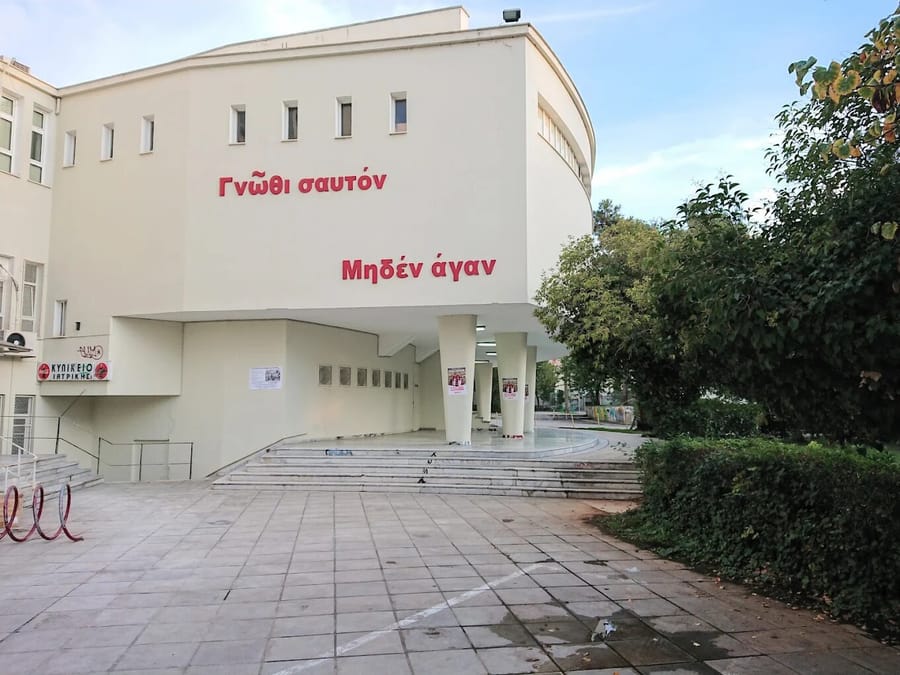
School of Medicine building at Aristotle University of Thessaloniki carrying the Delphic maxims Know Thyself and Nothing in Excess in red Greek lettering across the facade
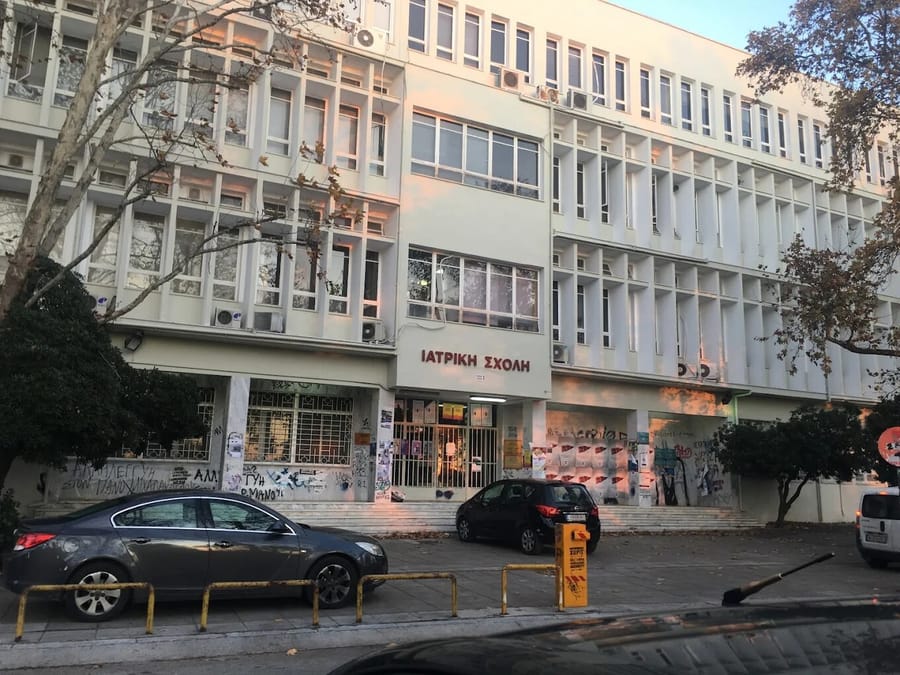
Street frontage of the School of Medicine at Aristotle University of Thessaloniki with Medical School signage in Greek above the entrance
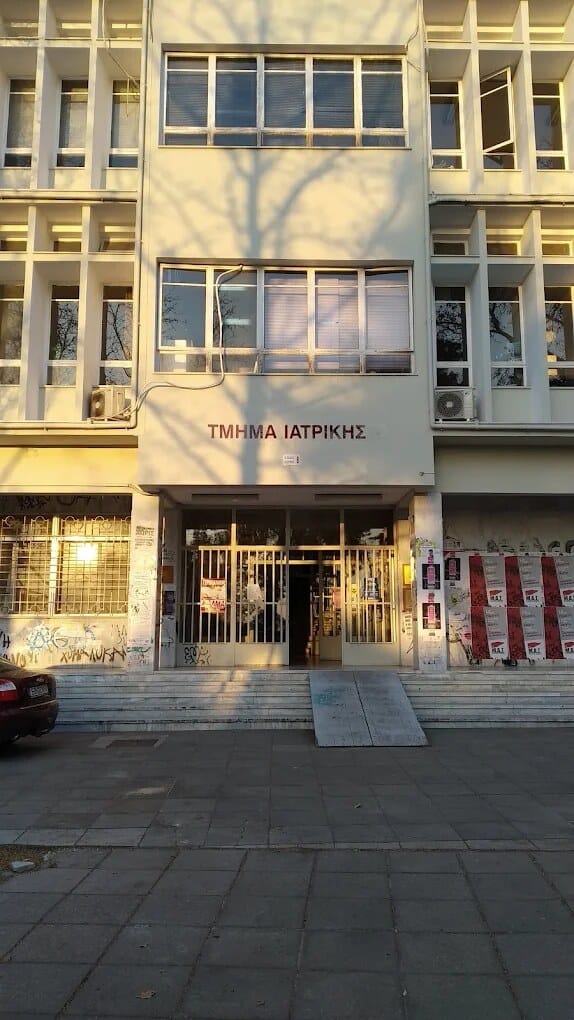
Entrance to a School of Medicine building at Aristotle University of Thessaloniki with departmental signage in Greek and student notices at the door

School of Medicine building at Aristotle University of Thessaloniki carrying the Delphic maxims Know Thyself and Nothing in Excess in red Greek lettering across the facade

Find out all about your MBBS-abroad options in Greece

Download our free brochure for immediate information, or get personalised professional counselling from our experts.

Recognition & Prestige

Rankings & Recognition

Aristotle University of Thessaloniki is the largest university in Greece, with around 88,000 students. Its School of Medicine is listed in the World Directory of Medical Schools (WDOMS), and the Greek medical degree, the Ptychio Iatrikis, is named in EU law. Its world rankings are below.

  • =502

    QS World University Rankings 2027

  • 801 to 1000

    Times Higher Education World University Rankings 2027

  • 501 to 600

    Times Higher Education 2026, Medical and Health

Clinical training runs across seven hospitals in Thessaloniki, all National Health System hospitals that host the university's clinical departments: AHEPA University Hospital on the university campus, Hippokration General Hospital, Papageorgiou General Hospital, G. Papanikolaou General Hospital, G. Gennimatas Agios Dimitrios General Hospital, the Psychiatric Hospital of Thessaloniki and the Hospital of Venereal and Skin Diseases. EU Directive 2005/36/EC lists the Greek degree at Annex V, point 5.1.1, with a reference date of 1 January 1981. Because the school is listed in WDOMS, graduates can apply for ECFMG Certification and the USMLE. The GMC lists the Ptychio Iatrikis as a relevant European qualification, so UK registration is applied for directly, without PLAB. For India, the degree meets most NMC rules; the open point is whether the year of clinical traineeships built into semesters 11 and 12 counts as the 12-month internship the NMC asks for, which the NMC decides for each graduate.

Accreditations and Recognition

  • World Directory of Medical Schools emblem

    WDOMS

    The Aristotle University of Thessaloniki School of Medicine is listed in the World Directory of Medical Schools

  • European Union emblem

    EU

    Greece is an EU member state, and the Ptychio Iatrikis is listed in Annex V, point 5.1.1 of EU Directive 2005/36/EC, reference date 1 January 1981

Complete Information About the Thessaloniki School of Medicine

Get complete information about the AUSoM programme, including tuition, living costs, admission and recognition for Indian students.

Success stories

Student Success Stories

Hear directly from students who are studying medicine in Europe with futureMBBS.

Academic Excellence

Why Study Medicine at Aristotle University of Thessaloniki

AUSoM was Greece's first English-taught medicine degree, with a clear fee, 60 places a year and two application rounds, in a city that costs less to live in than Athens. Against that there is no direct flight from India to Thessaloniki, and an open question over how the NMC treats the clinical year built into the degree. Both sides are set out below.

A Clear Fee, the Same Every Year

Tuition is €12,000 a year (about ₹12.7 lakh), the same in each of the six years, so €72,000 across the degree, about ₹76.3 lakh. It is paid in two instalments a year rather than as one lump sum.

Sixty Places and Two Application Rounds

The programme admits 60 students a year, with two application rounds closing on 31 January and 31 May. The admission test is taken online, so there is no need to travel to Greece to sit it.

Greece's First English-Taught Medicine Degree

The first class was admitted in September 2021, making AUSoM the first English-taught medicine programme in Greece. It has now run through five full years, and its first class graduates in 2027.

Greece's Largest University

Around 88,000 students study across the university and about 4,000 in the School of Medicine, taught in 82 departments and laboratories. These are organised into academic sectors covering anatomy and pathology, physiology and pharmacology, biological sciences, radiology and medical physics, neurosciences, and surgery and internal medicine.

A Teaching Hospital on Campus

Clinical training runs at AHEPA University Hospital, on the university campus, and at Hippokration, Papageorgiou, G. Papanikolaou and G. Gennimatas general hospitals, the Psychiatric Hospital of Thessaloniki and the Hospital of Venereal and Skin Diseases.

A Cheaper City Than Athens

Numbeo puts a one-bedroom flat outside central Thessaloniki at about €424 a month (about ₹44,900), against €563 in Athens, and a monthly transport pass at €16 (about ₹1,700), against €27. Day-to-day costs are similar; rent and transport are where the difference lies.

The Trade-Offs, Stated Plainly

There is no direct flight from India to Thessaloniki, so every journey connects through Athens or a hub. And the university's Engineering campus saw two serious security incidents in the first five months of 2026, set out in the Student Life section.

Plan Around the NMC Position

The six-year English-taught degree meets most NMC rules. Its final year, semesters 11 and 12, is a full year of clinical traineeships built into the degree, and the NMC has not said whether this counts as the 12-month internship it asks for. A graduate may be asked to complete a longer internship in India after the FMGE (NExT deferred and not in force), so a student aiming for India should plan this with our counsellors before applying.

Read all about MBBS abroad in our free brochure

Know exactly what options exist for your MBBS-abroad success.

How to Apply

Admission Process for AUSoM

Admission runs through the programme's own online admission test, a personal statement and a video interview, into 60 places a year across two application rounds. A NEET score is not one of the results that replace the test. A qualified NEET UG result is still a separate Indian requirement, needed before you join a medical course abroad.

Admission Timeline

  1. 1
    Before applyingQualify NEET UG

    Indian citizens and OCI holders need a qualified NEET UG result before joining a medical course abroad, and the result stays valid for three years from its declaration. This is an Indian requirement, entirely separate from the university's own selection, and on this programme it does not replace the admission test.

  2. 2
    By 31 January or 31 MayChoose an application round

    Applications close on 31 January and on 31 May, for one intake a year in September. Two rounds give an applicant a second chance within the same year.

  3. 3
    Prepare English evidenceB2 English proficiency

    IELTS 6.0 or above overall, or TOEFL 79 or above out of 120. Greek is not needed to apply.

  4. 4
    Sit the admission testAUSoM Admission Test, online

    Sixty multiple-choice questions on school Biology, Chemistry and reasoning, taken online with no travel to Greece. The university takes a €1,200 deposit (about ₹1.3 lakh) before the test, fully refunded if you are not admitted. MediTest-EU, or A-Levels at AAB or better on final results, remove the test. A NEET score does not.

  5. 5
    Submit the applicationDocuments, statement and interview

    Your school-leaving certificate or International Baccalaureate, English proficiency evidence, a personal statement, and an online video interview.

  6. 6
    After acceptanceDeposit, visa and residence permit

    Pay the €6,000 deposit (about ₹6.4 lakh, non-refundable), which counts towards the first year's fee, with the second instalment due at the end of the winter semester. Then apply for the national long-stay type D student visa at the Greek visa centre in New Delhi, showing funds of about €650 a month (about ₹68,900), and apply for the residence permit for studies within 90 days of arrival. Places cannot be deferred to the next year, so start the visa early.

Eligibility Criteria

Academic Qualification

The programme asks for a school-leaving certificate or an International Baccalaureate, English at B2, a personal statement and an interview. It is open only to foreign nationals who studied at least their last two school years outside Greece, which every Indian student schooled in India meets. Under Indian NMC rules an Indian applicant also needs Physics, Chemistry, Biology and English at Class 12, with at least 50% aggregate in Physics, Chemistry and Biology for the general category, 40% for SC, ST and OBC candidates and 45% for general-category candidates with benchmark disabilities, together with a qualified NEET UG result.

Subjects:

PhysicsChemistryBiologyEnglish

Age Requirement

Under Indian NMC rules the candidate must be 17 years old by 31 December of the admission year, with no upper age limit. The programme applies no separate age condition of its own.

  • Minimum 17 yearsAge to be completed by 31 December of the admission year, under Indian NMC rules

Requirements

Two things govern an AUSoM application.

  • The Admission Test, Sat Online

    Sixty multiple-choice questions on Biology, Chemistry and reasoning, taken online with no travel required. Only MediTest-EU or A-Levels at AAB or better remove the test. A NEET score does not, so an Indian applicant should plan to sit it.

  • Sixty Places and Two Rounds

    The programme admits 60 students a year across two application rounds, closing on 31 January and 31 May, for one September intake. Two chances in the same year give an applicant more room to plan.

Entrance Examination

Admission rests on the programme's own test together with the components below.

ComponentRequirement
AUSoM Admission Test60 multiple-choice questions on Biology, Chemistry and reasoning, sat online; MediTest-EU or A-Levels at AAB or better remove the test
English proficiencyB2: IELTS 6.0 or above overall, or TOEFL 79 or above out of 120
Academic qualificationSchool-leaving certificate or International Baccalaureate, with at least the last two school years studied outside Greece
Personal statement and interviewBoth required; the interview is held online by video

Required Documents

To apply, students need to submit essential academic and identification documents:

  • Class 12 certificate and marksheets for the last two school years, with official English translations
  • Evidence of English at B2: IELTS 6.0 or TOEFL 79
  • Personal statement and a CV in English
  • Valid passport
  • NEET UG scorecard, required separately of Indian nationals
  • + More

Admission Guidance & Document Checklist

Get the complete document checklist or admission guidance from our experts.

Programme Structure

MBBS Curriculum & Internship Structure

AUSoM runs six years and 360 ECTS across twelve semesters and 83 modules, taught in English. Greek Language I to VI run from the first to the sixth semester, with Greek Medical Terminology I and II in semesters five and seven. Taught courses run through semester 10, followed by seven clinical traineeships across semesters 11 and 12, worth 60 ECTS. The traineeships sit inside the degree and there is no separate internship after it, which is the point that matters for Indian students (see the FMGE section below).

Medicine Course

  • Total Duration:

    6 Years, 12 semesters, 360 ECTS, ending in seven clinical traineeships worth 60 ECTS

  • Degree:

    Ptychio Iatrikis (degree in Medicine, equivalent to MBBS)

Curriculum Phases at the Thessaloniki School of Medicine

  • Semesters 1 to 4

    Foundational Sciences

    The basic medical sciences together with early clinical skills, with Greek taught alongside as a compulsory subject:

    Medical BiologyMedical PhysicsAnatomyBiochemistry
    HistologyPhysiologyMedical InformaticsMedical StatisticsGeneticsEmbryologyEarly Clinical SkillsGreek Language
  • Semesters 5 to 6

    Pathology and Diagnostics

    Disease mechanisms and the diagnostic sciences, bridging the laboratory and the ward:

    General PathologyRadiologyPharmacologyMicrobiology
    Greek Medical Terminology I
  • Semesters 7 to 10

    Core and Specialty Clinical Medicine

    Clinical teaching across the major disciplines and then the specialties in the affiliated hospitals, completing the taught part of the degree:

    CardiologyNeurologyPsychiatryInternal Medicine
    SurgeryObstetrics and GynaecologyUrologyAnaesthesiologyOrthopaedicsPaediatricsGeriatricsGreek Medical Terminology II
  • Semesters 11 to 12

    Clinical Traineeships

    A full year of full-time supervised clinical training in the affiliated hospitals, seven clinical traineeships worth 60 ECTS in all, built into the degree:

    Internal Medicine IISurgery II (and Neurosurgery)Paediatrics IIObstetrics and Gynaecology II
    Neurology IIPsychiatry IIPrimary Care Medicine and General Medicine

Clinical Rotations

Clinical training runs across seven hospitals in Thessaloniki:

Clinical baseRole in training
AHEPA University HospitalThe flagship tertiary centre, on the university campus, and the closest thing the school has to an in-house teaching hospital
Hippokration General Hospital of ThessalonikiA major general hospital hosting university clinical departments across internal medicine and the specialties
Papageorgiou General Hospital and G. Papanikolaou General HospitalTwo further large general hospitals in the Thessaloniki network carrying university clinics
G. Gennimatas Agios Dimitrios General HospitalA general hospital hosting university clinical departments
Psychiatric Hospital of Thessaloniki and the Hospital of Venereal and Skin DiseasesSpecialist teaching sites for psychiatry and dermatology, alongside the general hospitals

Get the full curriculum

Download a free brochure to see detailed subjects, the course structure and everything you need to plan your studies.

European Framework

Recognition, the Greek System and the European Framework

A Greek medical degree sits inside the European professional qualifications framework, and the terms are national rather than set by each university. The table sets out what that means for this programme.

ItemDetail
EU Directive 2005/36/ECGreece is an EU member state, and the Ptychio Iatrikis is listed at Annex V, point 5.1.1, with a reference date of 1 January 1981. Automatic recognition across the EU applies to EU citizens, so an Indian graduate moves to another EU country through that country's own procedure for non-EU nationals
WDOMS listingThe School of Medicine is listed in the World Directory of Medical Schools, which opens the USMLE route to the United States through ECFMG
UK registrationThe General Medical Council lists the Ptychio Iatrikis issued by a Greek university as a relevant European qualification, so a graduate applies for full registration directly, without PLAB. The GMC bases this on where you qualified, not on nationality, and says it applies at this time under existing legislation
Programme launchThe English-taught programme admitted its first class in September 2021, and that class graduates in 2027
Eligibility restrictionOpen only to foreign nationals who studied at least their last two school years outside Greece; Greek nationals take the Greek-language degree
Licence to practise in GreeceApplied for online on gov.gr through the Panhellenic Medical Association, and open to graduates of a medical school in Greece or another EU country, whatever their nationality

Understand the Recognition Framework

The table above sets out where a Greek medical qualification is recognised and on what basis.

Legacy

The People and the Lineage

The university is named after Aristotle, was the first founded outside Athens, and is led by a cardiothoracic surgeon who graduated from its own medical school.

Professor Kyriakos Anastasiadis

Rector of Aristotle University of Thessaloniki, elected on 11 June 2025. A professor of cardiothoracic surgery, he has led that department at AHEPA University Hospital since 2011, chaired the Department of Medicine from 2020 to 2024, trained at the Oxford Heart Centre and is himself a graduate of this medical school.

Stefanos Triaridis

Head of the School of Medicine, with Pavlos Georgiadis serving as Secretary.

Faculty

The School of Medicine sits within the Faculty of Health Sciences and teaches around 4,000 students across 82 departments and laboratories, organised into academic sectors covering anatomy and pathology, physiology and pharmacology, biological sciences and preventive medicine, radiology, medical physics and informatics, sensory organs, child health and neurosciences, and surgery and internal medicine. The university as a whole enrols around 88,000 students, making it the largest in Greece.

Academic Expertise

  • Greece's largest university, with around 88,000 students

  • 82 departments and laboratories in the School of Medicine

  • Seven teaching hospitals, including AHEPA on the university campus

  • English-taught programme running since September 2021

Student Support & Mentorship

  • Sixty places a year on the English-taught programme

  • Two application rounds, closing on 31 January and 31 May

  • Admission test sat online, with no travel to Greece

  • Greek taught as a compulsory subject for clinical communication

About University

History Information

Founded in 1925

The university was established under Law 3341, signed on 5 June 1925 and published in the Government Gazette on 22 June, and it opened to students in 1926. It was the first Greek university founded outside Athens, and it is named after Aristotle, who taught at the Macedonian court under Philip II.

The School of Medicine, 1942

The School of Medicine was founded in 1942, during the German occupation of Greece, and it has taught medicine in Thessaloniki ever since.

Greece's Largest University

The university now enrols around 88,000 students, of whom roughly 77,000 are undergraduates, across twelve faculties and thirty-six schools, making it the largest university in Greece by both staff and student numbers.

The English-Taught Programme From 2021

In September 2021 the School of Medicine admitted the first class of its English-taught undergraduate programme, with sixty places a year open only to international applicants. It leads to the same Ptychio Iatrikis as the Greek-language degree, and its first class graduates in 2027.

Get all information about the Thessaloniki School of Medicine in our free brochure

Read on to find out how you can fulfil your dream of studying medicine in Greece.

Role in medicine

Role in medical education

Medicine at Greece's Largest University

Aristotle University of Thessaloniki enrols around 88,000 students overall and about 4,000 in its School of Medicine, taught across 82 departments and laboratories. It was the first Greek university founded outside Athens and remains the country's largest.

A Teaching Hospital on Campus

AHEPA University Hospital sits on the university campus. Clinical training extends across six further hospitals in Thessaloniki, all National Health System hospitals hosting the university's clinical departments.

The First to Open Greek Medicine to International Students

The English-taught programme launched in September 2021 was the first of its kind in Greece. Five Greek public universities now teach the six-year medicine degree in English, and Aristotle was the one that opened the way.

Get all information about the Thessaloniki School of Medicine in our free brochure

Read on to find out how you can fulfil your dream of studying medicine in Greece.

Cost of living

Living Cost in Thessaloniki

Thessaloniki is Greece's second city, with a metropolitan population of about 1.19 million, and it is cheaper than Athens on rent and transport. The table assumes a one-bedroom flat to yourself; sharing the 51 to 80 square metre flat the programme suggests, at about €450 a month, brings the rent down considerably. Rupee figures are at about ₹106 to the euro (October 2026).

Monthly Living Cost

Cost ComponentApproximate Amount
Accommodation (one-bedroom flat, outside the centre to city centre)₹44,900 to ₹58,200 (€424 to €549)
Groceries/meals₹31,800 to ₹42,400 (€300 to €400)
Public transport (monthly pass)₹1,700 (€16)
Utilities, internet, SIM and leisure₹29,700 to ₹40,300 (€280 to €380)
Get free MBBS guide

Average monthly living cost

₹1.08 lakh to ₹1.43 lakh (€1,020 to €1,345)

Housing

Accommodation

The university runs halls of residence, but for a fee-paying international student on this programme the practical route is the private rental market, and the programme's own guidance points there.

The University Halls of Residence

The university runs student halls with around 1,500 beds across four buildings, open in principle to foreign students. Places are allocated on need, with criteria centred on large or low-income families and social and economic hardship.

What the Programme Recommends

The International Studies Office gives new students a list of trusted letting agencies in Thessaloniki and cites about €450 a month (about ₹47,700) for a flat of 51 to 80 square metres. That is the sensible starting point for a budget.

The Private Market in Thessaloniki

Numbeo puts a one-bedroom flat in the city centre at about €549 a month (about ₹58,200) and one outside the centre at about €424 (about ₹44,900), with utilities adding about €198 (about ₹21,000) and internet about €27 (about ₹2,900).

Sharing Is the Normal Student Arrangement

Most students in Greek cities share a flat to keep costs down. Two students sharing the programme's suggested €450 flat pay about €225 each (about ₹23,900), well below the one-bedroom rates above.

Start With the International Studies Office

The office that runs the programme also handles housing referrals, so it is the right first contact for the private market near the medical campus and for where earlier classes have lived. Arrange a flat or a shared room before you fly, and keep money aside for the rental deposit.

Location Matters in the Clinical Years

The School of Medicine sits on the main campus beside AHEPA University Hospital, but the six other teaching hospitals are spread across Thessaloniki. A flat chosen for lectures may not suit the traineeship year, so think about the commute to ward rounds too.

Need accommodation details?

Get a full overview of housing options with our university guide, or reach out to an expert.

Food & Dining

Indian Food and Daily Life in Thessaloniki

Thessaloniki is a city of 1.19 million with a handful of Indian restaurants, fewer than Athens, so a student here should expect to cook most of the time.

Nargis Indian Restaurant is the established option, and a few other places serve Indian dishes alongside Italian or Mexican food. Athens, a short flight away, has a wider choice.

Location

How to Reach the Thessaloniki School of Medicine

Address

School of Medicine, Aristotle University of Thessaloniki, University Campus, Thessaloniki, Greece. The school sits on the university's main campus in central Thessaloniki, beside AHEPA University Hospital, and six further teaching hospitals are spread across the city. Thessaloniki is Greece's second city, roughly 300 kilometres north of Athens.

  • Nearest Airport

    Thessaloniki Airport Makedonia (SKG), with European and regional routes and no direct flight to India

  • Realistic Routing From India

    Fly to Athens, which IndiGo has served nonstop from Delhi and Mumbai since January 2026, then take the 55-minute onward flight; or connect through a hub such as Istanbul, Doha or Dubai straight into Thessaloniki

Your Roadmap to Success

Career Pathways After AUSoM

Graduates receive the Greek primary medical qualification, the same degree as the Greek-language class. It is the equivalent of an Indian MBBS rather than an Indian postgraduate MD.

Understand the Medical Licensing Pathway

A clear overview of the exams and requirements after graduation.

Practising in India

FMGE (NExT Deferred and Not in Force)

To practise medicine in India after graduating abroad, an Indian student qualifies NEET UG before admission, completes a course that meets the NMC rules, clears the NMC screening examination (the FMGE; NExT is deferred and not in force), completes a 12-month internship in India, and registers with the NMC or a State Medical Council. For a Greek degree the open point is the internship, and the steps below explain what that means.

  1. Step 1

    Course Length and Internship

    The NMC Foreign Medical Graduate Licentiate Regulations 2021 ask for at least 54 months of study and a 12-month internship in the same foreign institution. The six-year, 360-ECTS programme clears the course length. Its final year, seven full-time clinical traineeships worth 60 ECTS in semesters 11 and 12, is built into the degree and completed before it is awarded, and Greece has no separate internship after graduation. The NMC has not said whether this year counts as the internship; it assesses each graduate's documents individually.

  2. Step 2

    Teaching in English

    The programme is taught in English and no Greek is required for admission. Greek is taught as a compulsory subject, Greek Language I to VI plus Greek Medical Terminology, because the hospital years are spent with Greek-speaking patients.

  3. Step 3

    FMGE (NExT deferred and not in force)

    The National Board of Examinations in Medical Sciences conducts the FMGE twice a year with a pass mark of 150 out of 300. In the December 2025 session 42,872 candidates appeared and 10,262 qualified, a pass rate of 23.95%. In June 2025, 36,034 appeared and 6,707 qualified, 18.61%. The National Exit Test (NExT), intended to replace the FMGE, is deferred and not in force. NBEMS publishes no figure for Greece, because the first English-taught class graduates in 2027.

  4. Step 4

    Clinical Internship in India (CRMI)

    After clearing the FMGE, a foreign graduate completes a twelve-month Compulsory Rotating Medical Internship in India, and then registers with the NMC or a State Medical Council.

  5. Step 5

    Where This Leaves an Aristotle Graduate

    The NMC has often treated practice years inside a degree as part of the course rather than as a separate internship, so an Aristotle graduate may be asked to complete a longer internship in India to make up the difference. Plan this with our counsellors before applying, and keep the university's written description of the final year for the State Medical Council. The School of Medicine is also listed in WDOMS, which opens the USMLE route, and the GMC accepts the Greek degree for UK registration without PLAB.

Student Life Style

Student life at Aristotle University of Thessaloniki

Thessaloniki is Greece's second city, with a metropolitan population of about 1.19 million, cooler and wetter than Athens, and built around the largest university in the country.

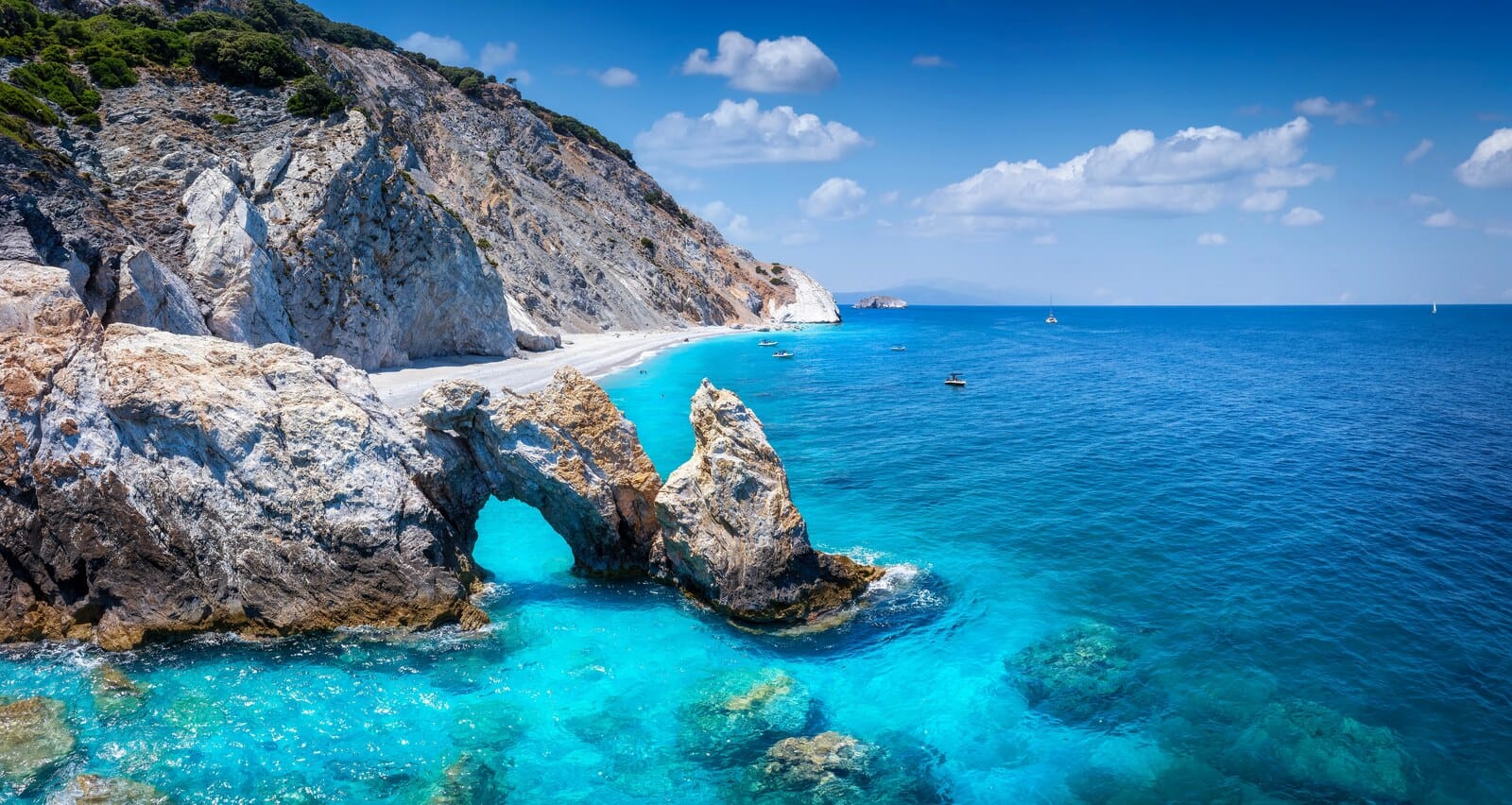
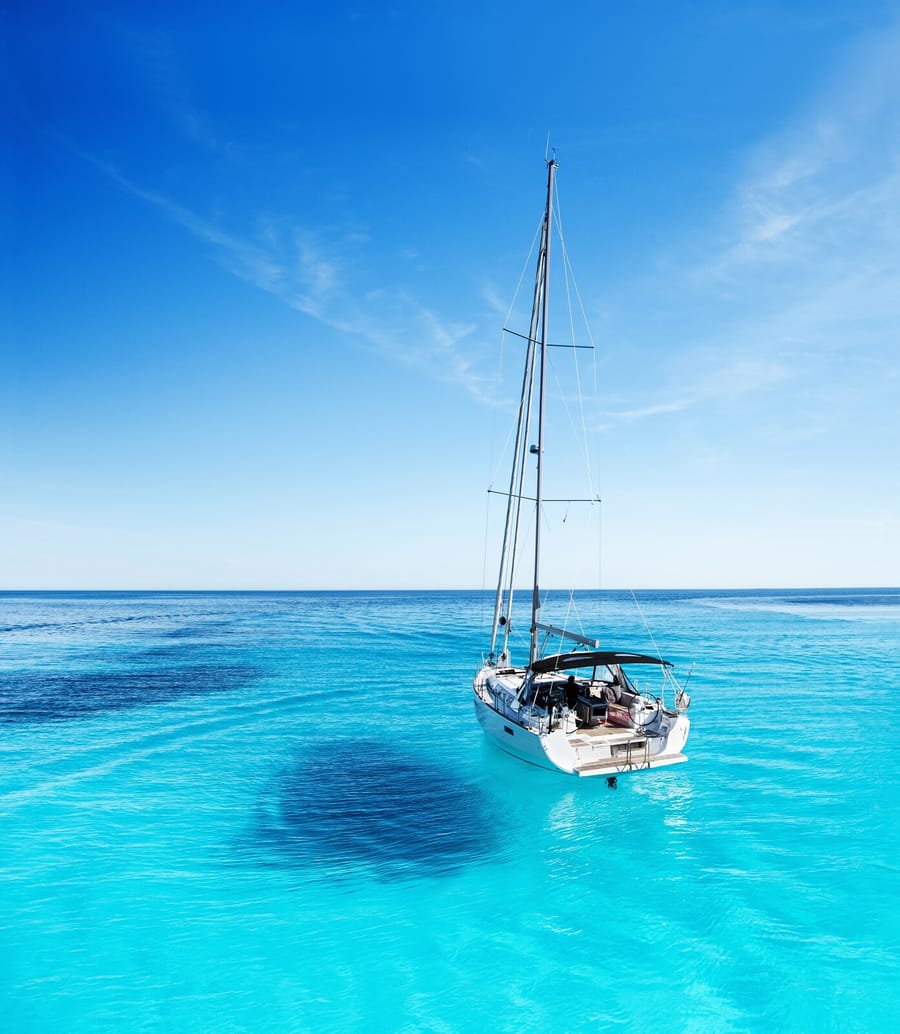
Sailing yacht at anchor on clear turquoise water off a Greek island coastline

Sailing yacht at anchor on clear turquoise water off a Greek island coastline

Cost, and How It Compares

Tuition is €12,000 a year, €72,000 over six years, about ₹76.3 lakh. Living costs are lower than in Athens: a one-bedroom flat outside the centre runs about €424 a month against €563, and a monthly transport pass €16 against €27. With the Greek academic ID card a Thessaloniki bus ticket costs €0.45 instead of €0.90, and the city's metro opened on 30 November 2024.

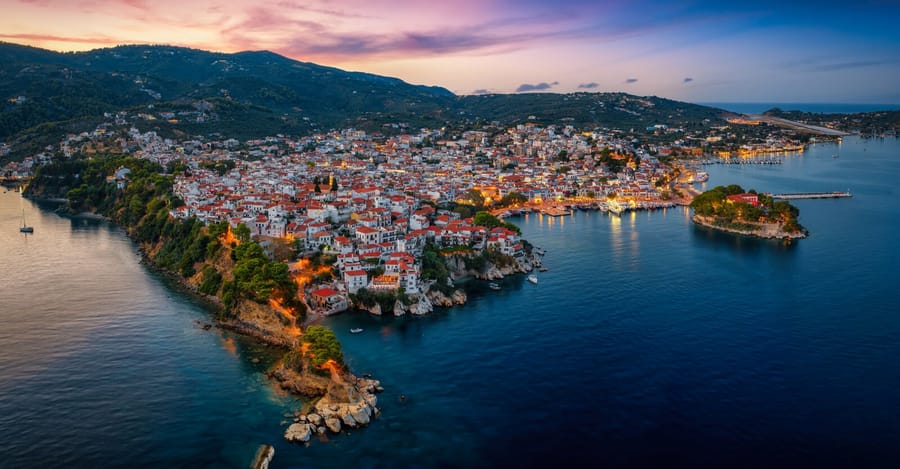
Aerial view of a Greek island town on a wooded headland at dusk

Aerial view of a Greek island town on a wooded headland at dusk

The Climate Is Cooler Than Athens

Thessaloniki averages about 4.2°C in January and 26.5°C in August, with an annual mean of 15.4°C and around 687 millimetres of rain. Athens averages 8.2°C in January and 27.4°C in August with only about 378 millimetres. Thessaloniki is noticeably colder and wetter in winter and slightly milder in summer.

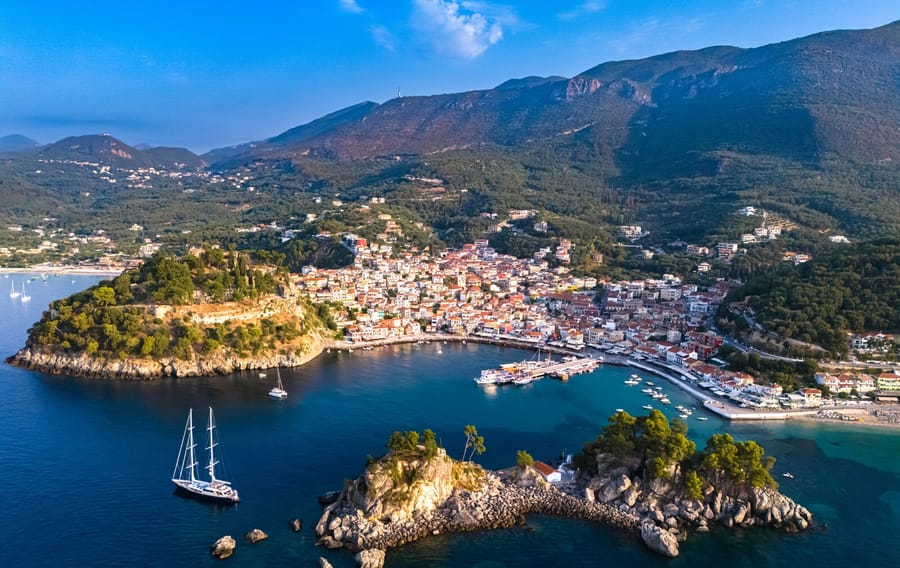
Aerial view of a Greek coastal town with a harbour, a wooded headland and mountains behind

Aerial view of a Greek coastal town with a harbour, a wooded headland and mountains behind

Campus Security in 2026

On 7 February 2026 an unauthorised party at the university's Engineering campus escalated into clashes with police; 313 people were detained and released without charge, one officer was injured, and the Education Ministry asked the university to explain its campus security. On 12 May 2026 an armed attack on a student political group inside the Engineering building injured seven people, who were taken to Papageorgiou Hospital. Both incidents centred on the Engineering campus, one part of a very large university, rather than on the School of Medicine.

Safety at the National Level

Greece ranks 53rd of 163 countries on the Global Peace Index 2026, with a score of 1.828, in the band the index describes as highly peaceful.

Getting Home Takes an Extra Leg

There is no direct flight between India and Thessaloniki. Every journey connects either through Athens, about 300 kilometres away and a 55-minute onward flight, or through a European or Gulf hub. IndiGo has flown nonstop from Delhi and Mumbai to Athens since January 2026.

Schengen and Travel

Greece is a long-standing Schengen member, so a Greek residence permit carries Schengen mobility. Thessaloniki Airport serves a range of European and regional routes, which makes travel within Europe straightforward.

Money and Payments

Greece is in the EU and the eurozone, so ordinary international transfers, cards and banking work normally. Tuition is paid in two instalments a year rather than as a single annual sum, which eases the cash flow.

Scholarship & Financial

Scholarship & Financial Aid

The programme offers no scholarships on its English-taught track, so a family should plan for the full fee from the start.

Tuition is €12,000 a year (about ₹12.7 lakh), the same in every year, so €72,000 across six years, about ₹76.3 lakh, paid in two instalments a year. The €6,000 deposit paid after the offer counts towards the first year's fee.

  • €12,000 a year × 6 = €72,000, about ₹76.3 lakh
  • Test deposit €1,200 (about ₹1.3 lakh), refunded if you are not admitted
  • Offer deposit €6,000 (about ₹6.4 lakh), counted towards the first year
  • Visa funds of about €650 a month (about ₹68,900)

Compare

Compare Colleges

Compare Aristotle University of Thessaloniki with India's top-ranked government medical college.

Quick Comparison:

Aristotle University of Thessaloniki vs AIIMS New Delhi

University
Aristotle University of ThessalonikiThessaloniki, Greece
AIIMS New DelhiNew Delhi, India
University TypePublic, founded 1925Institute of National Importance (government)
MediumEnglish, with compulsory Greek coursesEnglish
Course Duration6 years, 360 ECTS, including a final year of clinical traineeships in semesters 11 and 125.5 years, being 4.5 years plus a 12-month internship
Tuition (per year)€12,000, about ₹12.7 lakh (October 2026)About ₹1,628 in academic fees for the whole course, including ₹1,350 tuition
AdmissionOnline admission test and video interview, plus a qualified NEET UG resultNEET UG
RecognitionListed in WDOMS; EU Annex V 5.1.1; meets most NMC rules, and a longer internship in India may be asked forListed in WDOMS
Global RankingQS =502 (2027); THE 801 to 1000 (2027); THE Medical and Health 501 to 600 (2026)NIRF Medical 1 (2025)

Compare Top MBBS Universities for Me

See key differences in fees, ranking, eligibility and recognition.

Our blog

Medical Education Insights

Articles that turn complex MBBS-abroad rules into simple, practical steps for students and parents.

FAQ

Frequently Asked Questions

Short answers to the questions students and parents ask most often about studying medicine at Aristotle University of Thessaloniki.