



☝️ At a glance
Introduction
Students are protesting at Jantar Mantar in Delhi because the NEET UG 2026 exam, written by over 22.7 lakh aspirants on 3 May, was cancelled after a confirmed paper leak. The protests, now in their fourth week, demand the Education Minister's resignation, compensation for families of students who died, and reform of the NTA. The government agreed on 21 July to discuss NEET in Parliament.
Key Takeaways
Question | Verified Answer |
|---|---|
Why are students protesting? | NEET UG 2026 was cancelled after a paper leak matched up to 120 of 180 questions |
Where is the protest? | Jantar Mantar, New Delhi, with a march toward Parliament on 20 July, plus protests in Mysuru, Kolkata, Patna, and other cities |
Who is leading it? | The Cockroach Janta Party (CJP), a youth movement, with activist Sonam Wangchuk on hunger strike |
What are the demands? | Resignation of Education Minister Dharmendra Pradhan, Rs 1 crore for families of students who died, Wangchuk's unconditional release |
What has the government done? | BJP President J.P. Nadda held two rounds of talks; the government agreed on 21 July to a Parliament discussion |
Were leaders detained? | Yes. Rahul Gandhi, Priyanka Gandhi Vadra, and Akhilesh Yadav were detained on 21 July near the PM's residence |
What Sparked the NEET Protest 2026: The Paper Leak
The protests trace back to the morning of 3 May 2026, when over 22.7 lakh students sat for NEET UG, the single entrance exam for every MBBS seat in India. Within days, a chemistry teacher from Sikar, Rajasthan, Shashikant Suthar, compared a "guess paper" that had circulated through paid WhatsApp groups against the actual question paper and reported that nearly 140 questions matched. Investigators later confirmed an overlap of up to 120 of the 180 questions, concentrated in Chemistry and Biology.
The CBI investigation found the paper had been handwritten, scanned, and sold for around Rs 50 lakh per candidate through a network spanning Rajasthan and Maharashtra. Arrests included a Pune chemistry professor described as the kingpin, a Pune biology professor, and a Latur coaching institute owner, with 45 people detained in Latur and Nashik alone. Most damaging of all, the CBI found evidence the same racket had compromised the NEET UG 2025 paper as well, and all of this came just two years after the 2024 NEET controversy that reached the Supreme Court.
On 12 May 2026, NTA cancelled the exam. A re-exam was held on 21 June under armed escort for question papers, and results were declared on 16 July, with 11.21 lakh of nearly 20 lakh candidates qualifying. On paper, the crisis was resolved. On the streets, it was just beginning.
Full Timeline: From Cancellation to the Streets
Date | Event |
|---|---|
3 May 2026 | NEET UG 2026 held for over 22.7 lakh registered aspirants |
12 May 2026 | NTA cancels the exam; CBI takes over; protests erupt at Shastri Bhavan, Delhi and across states |
15 to 18 May 2026 | CBI arrests kingpin and co-accused; re-exam announced for 21 June; NEET to go computer-based from 2027 |
21 June 2026 | Re-exam held for nearly 20 lakh candidates; Telegram blocked nationwide until 22 June over fake leak claims |
Late June 2026 | Sonam Wangchuk begins an indefinite hunger strike at Jantar Mantar; CJP begins its sit-in |
16 July 2026 | Re-NEET results declared; 11.21 lakh qualify; protests continue regardless |
18 July 2026 | Wangchuk, 20 days into his fast, is shifted to a government hospital by Delhi Police after his health deteriorates |
20 July 2026 | CJP's "Sansad Chalo" march: tens of thousands converge on central Delhi; baton charges, tear gas, and a mobile internet shutdown reported |
21 July 2026 | Rahul Gandhi, Priyanka Gandhi Vadra, and Akhilesh Yadav detained near the PM's residence; government agrees to a Parliament discussion |
22 July 2026 | Sit-in continues at Jantar Mantar; NEET to be raised in the Monsoon Session of Parliament |
Inside the Jantar Mantar Protest: What Is Actually Happening
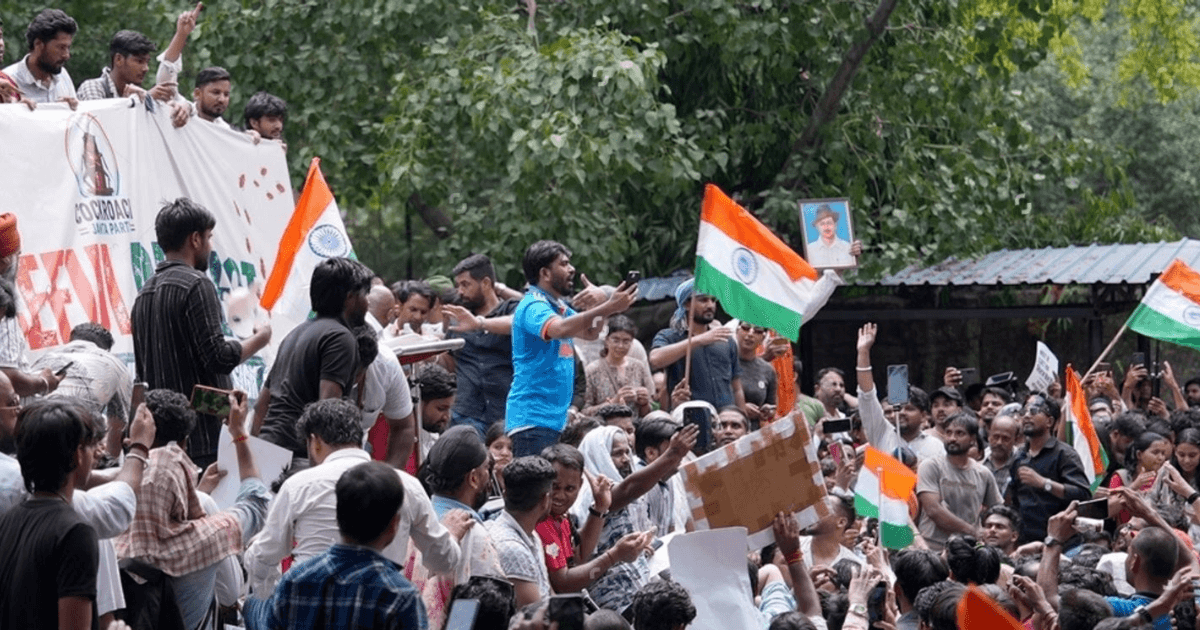
What began as a students' sit-in has become one of the largest youth-led demonstrations India has seen in years. Hundreds of protesters camped overnight at Jantar Mantar before the 20 July "Sansad Chalo" march, and by morning tens of thousands had gathered despite prohibitory orders and barricades across central Delhi. When crowds attempted to move toward Parliament, police responded with baton charges and tear gas.
The scale of the state response tells its own story. Authorities suspended mobile internet across central Delhi on 20 July, the first widespread communications blackout in the capital since the 2021 farmers' agitation. Journalists at the site reported relying on WiFi from nearby shops to transmit photos and videos. Union Home Minister Amit Shah monitored the situation through the day, with security personnel instructed to use minimum force.
The crowd itself is worth understanding. Reporters on the ground describe a gathering dominated by students and first-time protesters, joined by young professionals and even ex-servicemen.
The protests are not limited to Delhi. Students in Mysuru marched demanding the minister's resignation. Demonstrations have been reported in Kolkata, Patna, where protesters demanded an impartial probe into a student's death, and across Tamil Nadu, where Chief Minister Vijay and former CM M. K. Stalin have both demanded NEET be scrapped or suspended for the year.
Who Is the CJP and Who Is Sonam Wangchuk in This Protest?
The Cockroach Janta Party (CJP) is a youth-led movement formed in early 2026, not a registered political party. It began as a satirical response to remarks that allegedly described unemployed youth and activists as "cockroaches," and has since evolved into a platform focused on examination reform and youth employment, according to India-West. Its founder, Abhijeet Dipke, has led the Jantar Mantar sit-in, and the NEET paper leak turned the group's cause into a national flashpoint.
Sonam Wangchuk, the Ladakh-based climate activist, joined the protest with an indefinite hunger strike at Jantar Mantar. On 18 July, twenty days into the fast, Delhi Police shifted him to a government hospital after his health deteriorated. Videos of his removal spread widely on social media and intensified the protests. From his hospital bed, Wangchuk released a handwritten note announcing he would extend his fast after witnessing the treatment of peaceful protesters.
The Three Demands on the Table
In two rounds of talks with BJP President J.P. Nadda, CJP spokespersons Saurav Das and Ashutosh Ranka submitted a written memorandum with three demands, as reported by IANS via India-West. First, the unconditional release of Sonam Wangchuk. Second, the resignation of Union Education Minister Dharmendra Pradhan, who has admitted there was a "breach in the command chain" at NTA. Third, Rs 1 crore in compensation for the families of NEET aspirants who died by suicide following the controversy. Media reports have confirmed at least three student suicides linked to the distress of the cancellation.
Nadda described the talks as cordial but offered no assurances, appealing instead for the month-long sit-in to be withdrawn. That gap between dialogue and concession is why the crowds have not gone home.
The Government's Response So Far
Prime Minister Narendra Modi has called the paper leak a "ghor paap" (grave sin) and promised the strictest action against those responsible. On 21 July, after Congress President Mallikarjun Kharge, Rahul Gandhi, and Priyanka Gandhi Vadra staged a sit-in near the Prime Minister's residence, Union Minister Jitendra Singh and the Union Home Secretary met the leaders and announced the government had accepted the demand for a Parliament discussion on NEET. The same evening, Rahul Gandhi, Priyanka Gandhi Vadra, and Samajwadi Party chief Akhilesh Yadav were detained by Delhi Police.
Structural changes are also on the record. NEET UG will move to a fully computer-based format from 2027, per the Education Minister's May announcement. The Supreme Court has demanded a status report on the reform recommendations made after the 2024 leak, and a doctors' federation has petitioned to make NTA a statutory body answerable to Parliament. The NEET paper leak is listed for discussion in the ongoing Monsoon Session.
Why the Anger Runs So Deep: The Numbers Behind the Protest
The fury at Jantar Mantar is not about one leaked paper. It is about what that paper decides. Walk through the 2026 funnel: over 22.7 lakh students registered in May, nearly 20 lakh appeared for the June re-exam, and 11.21 lakh qualified. They are now competing for approximately 1.18 lakh MBBS seats in India, of which only around 55,000 are in government medical colleges. Roughly one in ten qualified candidates will get any MBBS seat, and barely one in twenty will get a government seat.
When a system that narrow is compromised twice in three years (2024, and now a racket that touched both the 2025 and 2026 papers), students are not just protesting a leak. They are protesting the possibility that the years they spent preparing were priced at Rs 50 lakh for someone else. That is the sentence in this story that every parent at Jantar Mantar would recognise.
FAQs
Why are students protesting NEET 2026?
Students are protesting because the NEET UG 2026 exam of 3 May was cancelled after a confirmed paper leak in which up to 120 of 180 questions matched a pre-circulated paper sold for around Rs 50 lakh. Protesters demand accountability from NTA and the Education Ministry, and compensation for families of students who died.
Where is the NEET protest happening?
The main protest is at Jantar Mantar in New Delhi, where the CJP has held a sit-in for over a month, with a "Sansad Chalo" march toward Parliament on 20 July 2026. Related protests have taken place in Mysuru, Kolkata, Patna, and cities across Tamil Nadu.
What is the Cockroach Janta Party (CJP)?
The Cockroach Janta Party is a youth-led protest movement formed in early 2026, not a registered political party. It began as a satirical response to remarks allegedly calling unemployed youth "cockroaches" and now campaigns on examination reform and youth employment. Its founder is Abhijeet Dipke.
What happened to Sonam Wangchuk at Jantar Mantar?
Sonam Wangchuk held an indefinite hunger strike at Jantar Mantar over the NEET 2026 controversy. On 18 July 2026, twenty days into the fast, Delhi Police moved him to a government hospital after his health deteriorated. He announced from hospital that he would extend his fast.
What are the protesters' demands?
The CJP memorandum submitted to BJP President J.P. Nadda lists three demands: the unconditional release of Sonam Wangchuk, the resignation of Union Education Minister Dharmendra Pradhan, and Rs 1 crore compensation for families of NEET aspirants who died by suicide after the paper leak.
Why was mobile internet shut down in Delhi?
Authorities suspended mobile internet across central Delhi on 20 July 2026 during the "Sansad Chalo" march, citing security around the Parliament area.
All about MBBS

 Copy Link