




☝️ At a glance
- Mock tests simulate the actual NEET exam, help understand question patterns, and test concept application across chapters.
- Start with topic or sectional tests, move to syllabus-based tests, and focus on full-length mocks in the last 6 months.
- Around 25–30 full-length mocks for first-timers and 35–45 for repeaters are enough if analysed properly.
- Identifying conceptual, silly, and time-management mistakes and revising weak areas leads to consistent score improvement.
Introduction
Mock tests play an important role in NEET preparation. Mock tests are not just practice papers but a sample of the real exam. A well-structured NEET mock test can help aspirants understand the exam pattern, question distribution, difficulty level, and many other aspects of the real exam. More importantly, mock tests bring together concepts from multiple chapters, similar to how questions appear in NEET, often inspired by previous years’ questions (PYQs).
Many students focus heavily on completing the syllabus but underestimate the value of mock tests. This is where preparation often remains incomplete. Mock tests simulate the real NEET environment, test conceptual clarity, and reveal weaknesses that are otherwise easy to miss during regular study. Giving mock tests regularly and using them correctly can significantly improve accuracy, speed, and confidence.
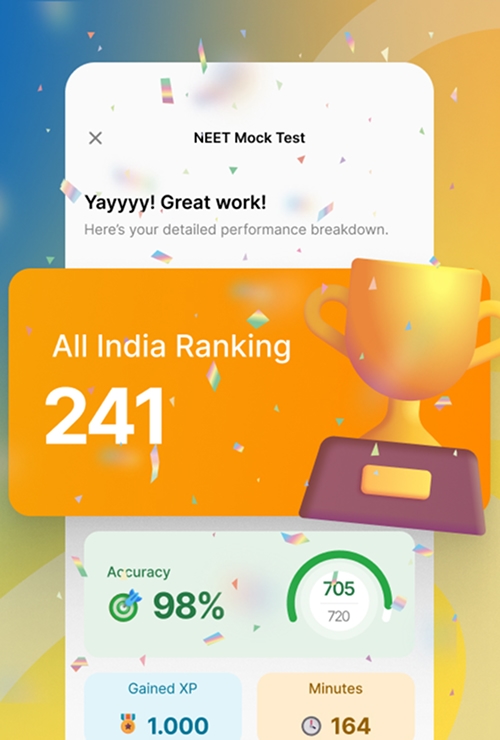

Crack NEET with the NEETsheet App – India’s Best NEET Prep Tool
- Full-Length Mock Tests
- Free Test Series
- Chapter-wise MCQs
- Solved PYQs
- Performance analytics
- Customisable Tests
Start preparing like a pro with a 7-day free trial!


How to prepare
Mock tests are most effective when attempted with proper preparation.
- Before starting mock tests, ensure that a reasonable portion of the syllabus is covered.
- In the early phase, even partial syllabus tests are useful, but jumping into full-length mocks without conceptual clarity can be counterproductive. Each mock should align with what you have studied so far.
- A quick revision before the test is essential. Focus on formulas, diagrams, reaction mechanisms, and key NCERT lines. This is not the time to learn something new. The goal is to recall and apply what you already know.
- Approach every mock test as a learning tool, not a judgment of your ability. Anxiety and overthinking reduce performance. Sit for the test with a calm mindset, follow exam rules strictly, and avoid unnecessary breaks. Treat it exactly like the real NEET exam.
When should you start giving mock tests
Early preparation phase
In the initial stage of preparation, topic-wise or chapter-wise mock tests are ideal. These help in strengthening fundamentals and building confidence gradually. At this stage, the focus should be on accuracy rather than score.
Mid-preparation phase
Once a major portion of the syllabus is completed, sectional and syllabus-based mock tests should be introduced. These tests improve time management and help aspirants understand how questions from different chapters are mixed.
Last 6 months strategy
The final six months are crucial. Full-length mock tests should become a regular part of the routine. These tests help simulate exam pressure, improve stamina, and fine-tune strategy. Regular analysis during this phase can lead to noticeable score improvement.
Click here to download the NEET Zoology chapter-wise weightage
Download PDFHow many mock tests are enough for NEET
There is no fixed number, but quality always matters more than quantity.
- First-time aspirants should focus on giving a moderate number of well-analysed mock tests. Around 25–30 full-length tests, combined with sectional tests, are sufficient if analysed properly.
- Repeaters generally benefit from more practice. Since the syllabus is already familiar, they can attempt 35–45 full-length mock tests with detailed analysis.
- In the early stages, one mock test every two weeks works well. As the exam approaches, the frequency can increase to one or two mocks per week. Daily mock tests are not recommended unless analysis time is equally prioritised.
How to attempt NEET mock tests
Allocate time based on your strengths. Biology should ideally be completed first, followed by Chemistry and Physics. However, students should customise this order based on comfort and accuracy.
Not all questions need to be attempted in sequence. Start with questions you are confident about. This builds momentum and reduces stress. Difficult or time-consuming questions can be revisited later.
Blind guessing should be avoided. Intelligent elimination can be used only when at least two options are clearly incorrect. Protecting marks is as important as attempting questions.
Click here to download the NEET Botany chapter-wise weightage
Download PDFThe right way to analyse NEET Mock Tests
Mock test analysis is where real improvement happens.
- Errors should be classified into three types: conceptual mistakes, silly mistakes, and time-management errors. This helps in understanding the root cause rather than blaming low scores.
- Maintain a record of chapters where mistakes are repeatedly occurring. These chapters need focused revision and additional practice.
- Based on analysis, create short-term goals. This may include revising specific topics, practicing numerical questions, or improving reading accuracy in Biology.
How to improve scores using mock tests
- Mock test results should guide revision. Instead of revising everything, focus on areas where marks are being lost repeatedly.
- Reattempt incorrect questions after revision. This reinforces concepts and ensures the same mistakes are not repeated.
- Mock tests reveal which chapters frequently appear and where accuracy is low. Strengthening these areas can lead to a significant score boost.
Click here to download the NEET Chemistry chapter-wise weightage
Download PDFOnline vs offline mock tests
- Online mock tests offer flexibility, instant analysis, and performance tracking. Offline tests provide a pen-paper experience similar to the actual exam.
- A combination of both works best. Online tests are more practical for regular practice, while occasional offline tests help in adapting to the exam environment.
Best NEET preparation apps
A good NEET preparation app can simplify mock test planning and analysis. Apps like NEETsheet help aspirants stay organised and consistent. Most apps are only testing you, but NEETsheet is built differently; it focuses on progress, not just performance. It has smart analytics highlight weak areas, time spent per question, and accuracy trends, making improvement more structured and data-driven.
Conclusion
Mock tests are not just assessments; they are preparation tools that shape exam readiness. A disciplined mock test strategy improves time management, accuracy, and confidence. When combined with proper analysis and targeted revision, mock tests can transform preparation and significantly improve NEET rank.
Success in NEET 2026 will not depend on how many hours you study, but on how intelligently you practise. Used correctly, mock tests can become the strongest pillar of your NEET preparation.
Click here to download the NEET 2026 official syllabus.
Download PDFFrequently asked questions
When should I start mock tests for NEET 2026?
Start with topic-wise tests after basic concepts are clear. Full-length mocks should begin in the last 6 months.
How many mock tests are enough?
First-timers: 25–30 full-length mocks
Repeaters: 35–45 full-length mocks
Proper analysis is more important than numbers.
Should I give daily mock tests?
No. Daily mocks without analysis reduce effectiveness. Balance testing and revision.
What is the best order to attempt sections in NEET mocks?
Usually Biology, then Chemistry, then Physics. Adjust based on your strengths.
How should I analyse mock tests?
Classify mistakes, track weak chapters, and revise only what is costing you marks.
All about MBBS

 Copy Link